
Well, hello from the tundra, where I now live. THIS IS NOT WHAT I MEANT WHEN I SAID I WANTED SNOW. We are literally frozen in a thick layer of snow-sleet-slush (I actually have heard people calling it “snow-ment”) and my hands barely work from all the attemps to break up the ice and shovel. I guess I will emerge from my home in the spring. See you then.
This week’s must read: from our western friends
We have said it before and we will say it again: we love this op-ed/LTE collaboration happening out in the western mountain states. Op-ed veterans Madeline Dalrymple and Alex Amonette are joined by R
“Successive administrations from both parties have selectively obstructed certain types of energy projects, contributing to uncertainty and delay. Growing energy concerns are creating pressure for unilateral actions, leaving communities without access to affordable power, new jobs, and private investment,” they write. “A coordinated national approach to permitting reform would benefit everyone. Stable, predictable permitting is essential for all energy developers. That is why we appreciate the Congressional Problem Solvers Caucus’s endorsement of a bipartisan permitting reform framework.”

Tea spilling, POSTPONED
Due to after effects of the inclement weather—lack of electricity (Bob), kids out of school (Angela), and one very sore throat (me)—we decided to postpone our Ask Bob Anything webinar for one week. If you were already registered, we hope you can still make it. If you thought you had a conflict, we hope you have room in your schedule for us now.
Bob spills the tea on February 3rd, 1:30ET/10:30PT. Register if you haven’t already. And get your tea ready! My favorite is this cinnamon variety
PROVE IT Act included in spending bill
A bit of cheer during these cold, dark times: The “Providing Reliable, Objective, Verifiable Emissions Intensity and Transparency (PROVE IT) Act” — introduced by Senators Kevin Cramer (R-N.D.), Chris Coons (D-Del.) and John Curtis (R-Utah) — was included in the “mini-bus” that was signed into law last week. The provision requires the Department of Energy to commission a study comparing the carbon intensity of certain domestically-made goods to the goods produced in other countries. The data could potentially guide imposing carbon border adjustments on countries whose products are not as efficient as U.S. products.
“The more surgical and the more you can validate with economics a tariff, I think the more durable it is, and the more sustainable it is in the global marketplace,” said Cramer.
“It’s encouraging for us who work in the climate and trade space, that things can still move,” noted Shuting Pomerleau, director of energy and environmental policy at the American Action Forum (and past webinar and podcast guest).
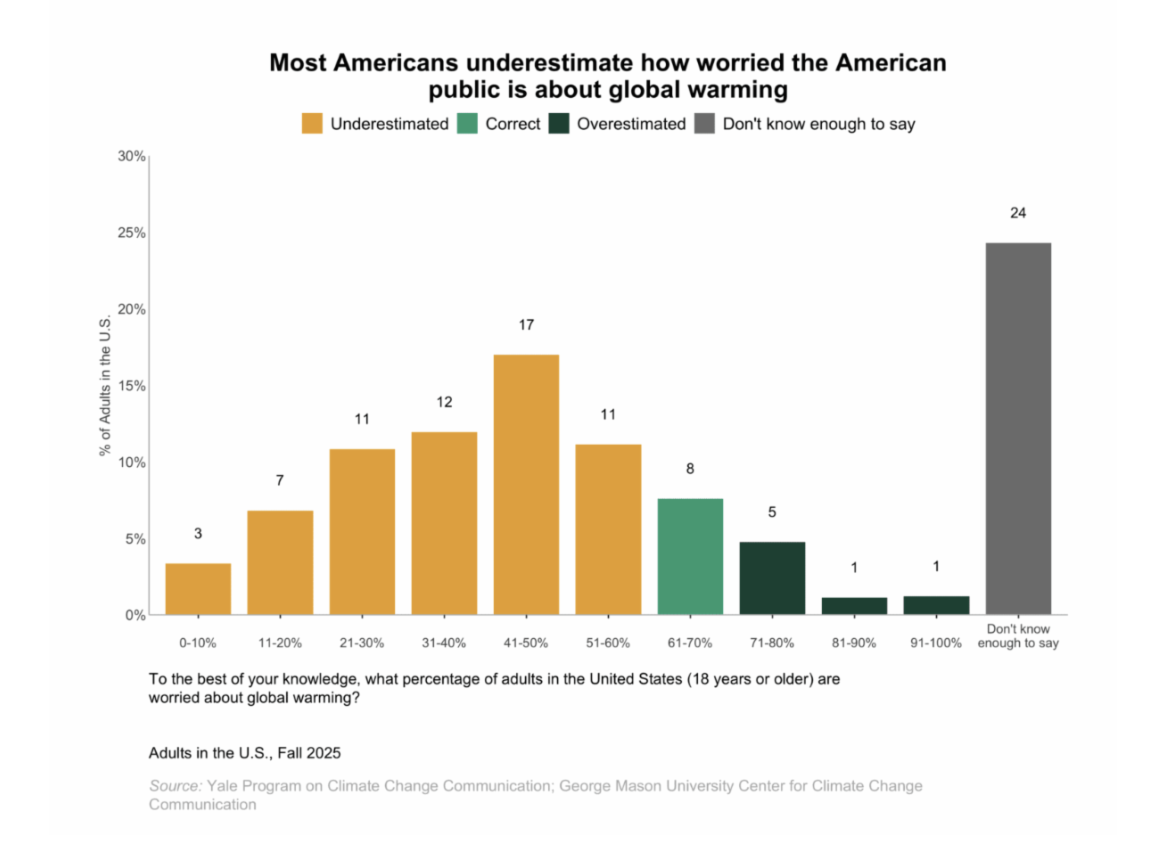
More Americans believe climate change is happening than not by 5:1…. REALLY!
Check out the lastest edition of Climate Change in the American Mind, an annual report is based on findings from a nationally representative survey and conducted jointly by the Yale Program on Climate Change Communication and the George Mason University Center for Climate Change Communication.
Key findings of the report:
- Americans who think global warming is happening outnumber those who think it is not by a ratio of more than 5 to 1 (72% versus 13%).
- 64% of Americans say they are at least “somewhat worried” about global warming. However, 85% of Americans either underestimate how many Americans are worried, or don’t know enough to say. (See chart above)
- Only 17% of Americans say they hear about global warming in the media “at least once a week,” which is the lowest percentage since the question was added to the survey in 2015.
If you want to learn more, be sure to tune in to the EcoRight Speaks on February 24th with Mason 4C’s John Kotcher, who discusses findings from this latest research.
How to communicate climate change: Katharine Hayhoe on the Electric Ladies Podcast
We’re back in action next week, but in the meantime, you can listen to the ever wise Dr. Katharine Hayhoe on the Electric Ladies Podcast as she addresses a range of topics from climate adaptation to protecting climate data to bridging climate science and faith.
“We have a couple of key misconceptions that are really stading in our way,” of briding the divide on climate change, Dr. Hayhoe notes. “We have to begin our conversations with what really mattters to the person or people we’re speaking with. And if we don’t know what that is, we have to get to know them and build a relationship and then start the conversation with where they’re at, not where we want them to be.”
Also: don’t load up your conversations with scientific stats! And remember: we need a diversity of voices!
She has great advice and I recommend you not only listen to this episode but read her book, Saving Us: A Climate Scientist’s Case for Hope and Healing in a Divided World.